Quote of the week
“A man on a thousand-mile walk has to forget his ultimate goal and say to himself every morning, 'Today I'm going to cover twenty-five miles and then rest up and sleep.”
— Leo Tolstoy

Edition 26 - June 29, 2025
“A man on a thousand-mile walk has to forget his ultimate goal and say to himself every morning, 'Today I'm going to cover twenty-five miles and then rest up and sleep.”
— Leo Tolstoy
New York is planning its first new nuclear power plant in decades, aiming to deliver at least one gigawatt of zero-emission energy — enough to power around a million homes. Early planning is already underway, with options including either a large traditional reactor or a series of small modular reactors. It’s a major move in a state that’s spent more time shutting down nuclear plants than building them.
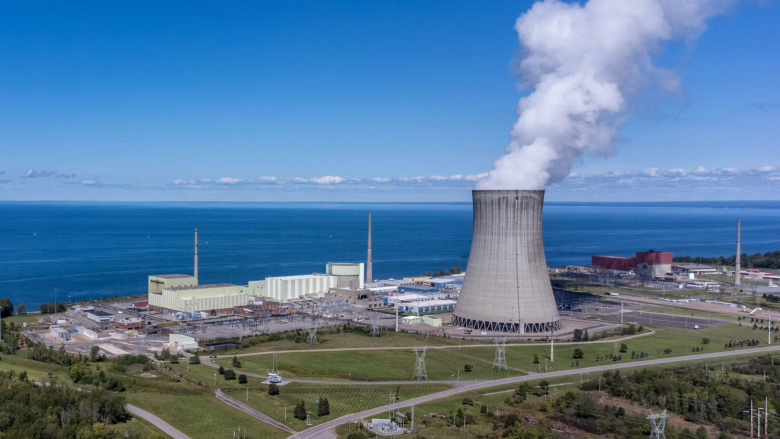
The reason is simple: electricity demand is exploding thanks to AI, data centers, and electrification in general. Leaders finally realized you can’t run all that on solar and wind alone. Nuclear offers clean, reliable baseload power, and while the timeline is long (expect at least 10 to 15 years before this thing goes live) officials hope modular designs will keep costs and delays from spiraling out of control. Critics say it’s too expensive and too slow. But if you want dependable energy, there aren’t many better options.
And it’s not just New York. The entire US needs to wake up. Power demand is surging, and our buildout isn’t even in the same league as China’s. Take a look at the chart I’m dropping below. While they’re adding capacity like their future depends on it, we’re busy debating permitting reform. If we don’t pick up the pace, we’ll fall too far behind.
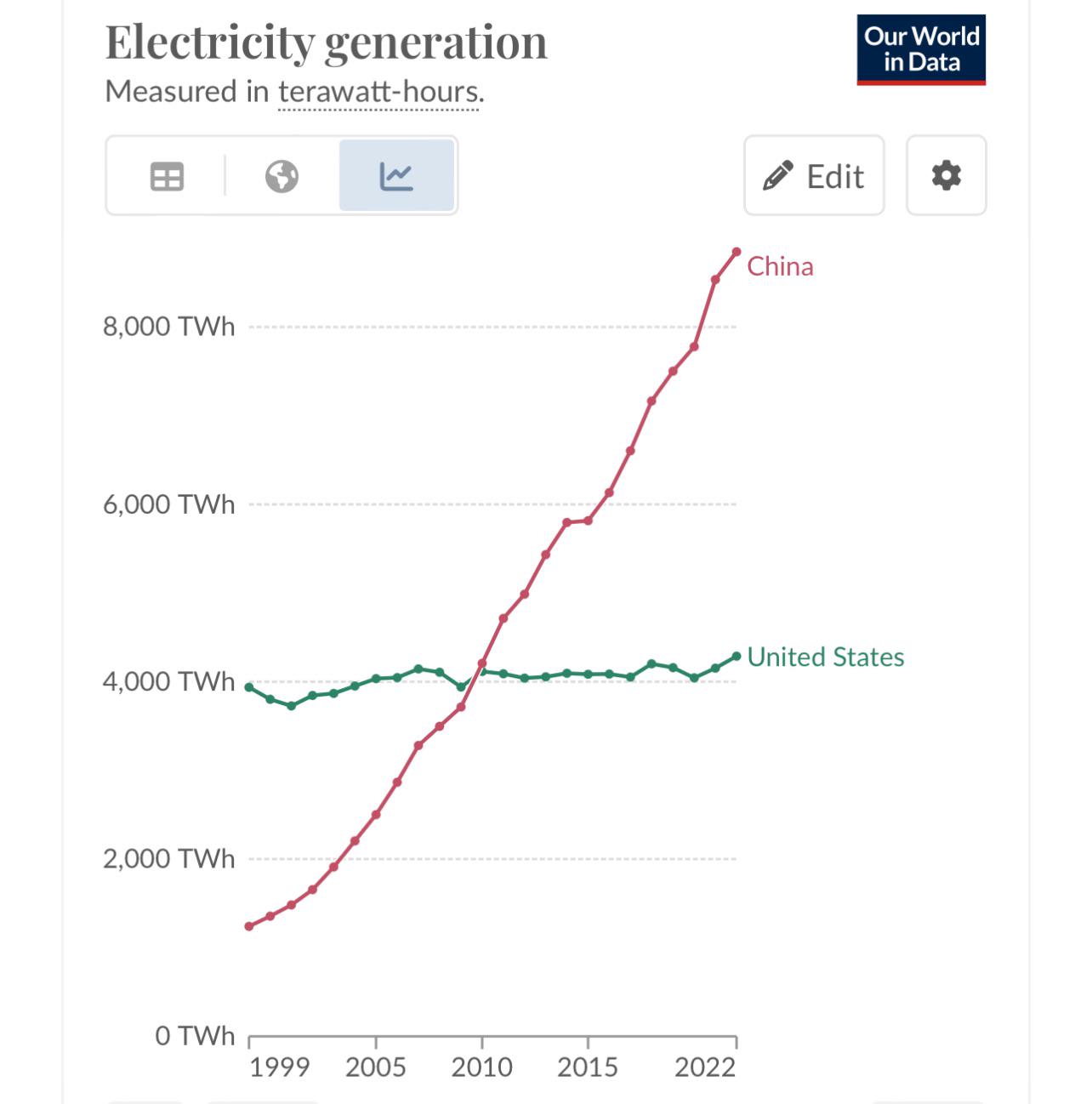
This isn’t just about AI. More power unlocks everything — cheaper prices, new industries, faster compute, cheaper housing construction, cleaner water processing, better healthcare devices, and the infrastructure to support a rapidly aging population. A nation that can’t scale its energy supply won’t scale much else either. These new nuclear reactors are safe; we'll see if the burden of unchecked over-regulation takes its toll.
The most powerful digital telescope camera ever built just took its first test drive and casually found millions of galaxies and over two thousand brand-new asteroids. In ten hours. It packs 3,200 megapixels and can scan huge chunks of the night sky in seconds. Among the fresh discoveries were seven near-Earth asteroids (don’t worry, none are headed our way). The early images are stunning. Galaxy clusters, colorful nebulas, crystal-clear detail. This thing is a beast.

And it’s just getting started. Over the next ten years, this telescope will repeatedly scan the southern sky and create a kind of cosmic time-lapse. Billions of objects tracked. Supernovae caught as they happen. A deeper look at weird space mysteries like dark matter and dark energy. It’ll also dump out an absolutely massive amount of data, giving researchers a real-time view of how the universe is changing. Basically, we’re filming the evolution of the cosmos, and the footage is going to be wild.
To put it simply, socialism is the belief that major industries or the means of production should be owned or regulated collectively (often through the state) with the goal of reducing inequality. In practice, it often leads to central planning, where officials decide what gets made, by whom, and at what cost. It sounds nice in theory, especially when framed around fairness or equality, but it doesn’t usually play out that way. Instead, it tends to create shortages, inefficiencies, and dependence. Innovation slows. Incentives erode. And the system becomes more about control than prosperity.

I’m writing about this now because New York City might elect a mayor who openly identifies as a democratic socialist. Leadership sets tone and policy, and in a city that already struggles with affordability, crime, and economic vitality, adding centralized control and redistribution isn’t the solution. It’s tempting to vote for the person who promises free stuff, but we should be asking what the tradeoffs are and whether the system they support actually delivers for the people. No matter your views, you have to admit that Zohran is a powerful speaker. And I understand the desire to vote for him (not just because the other candidates are terrible) - a lot of people feel like the system is failing them. I feel very strongly that the problem is not capitalism, it's poor policy and corrupt leaders.
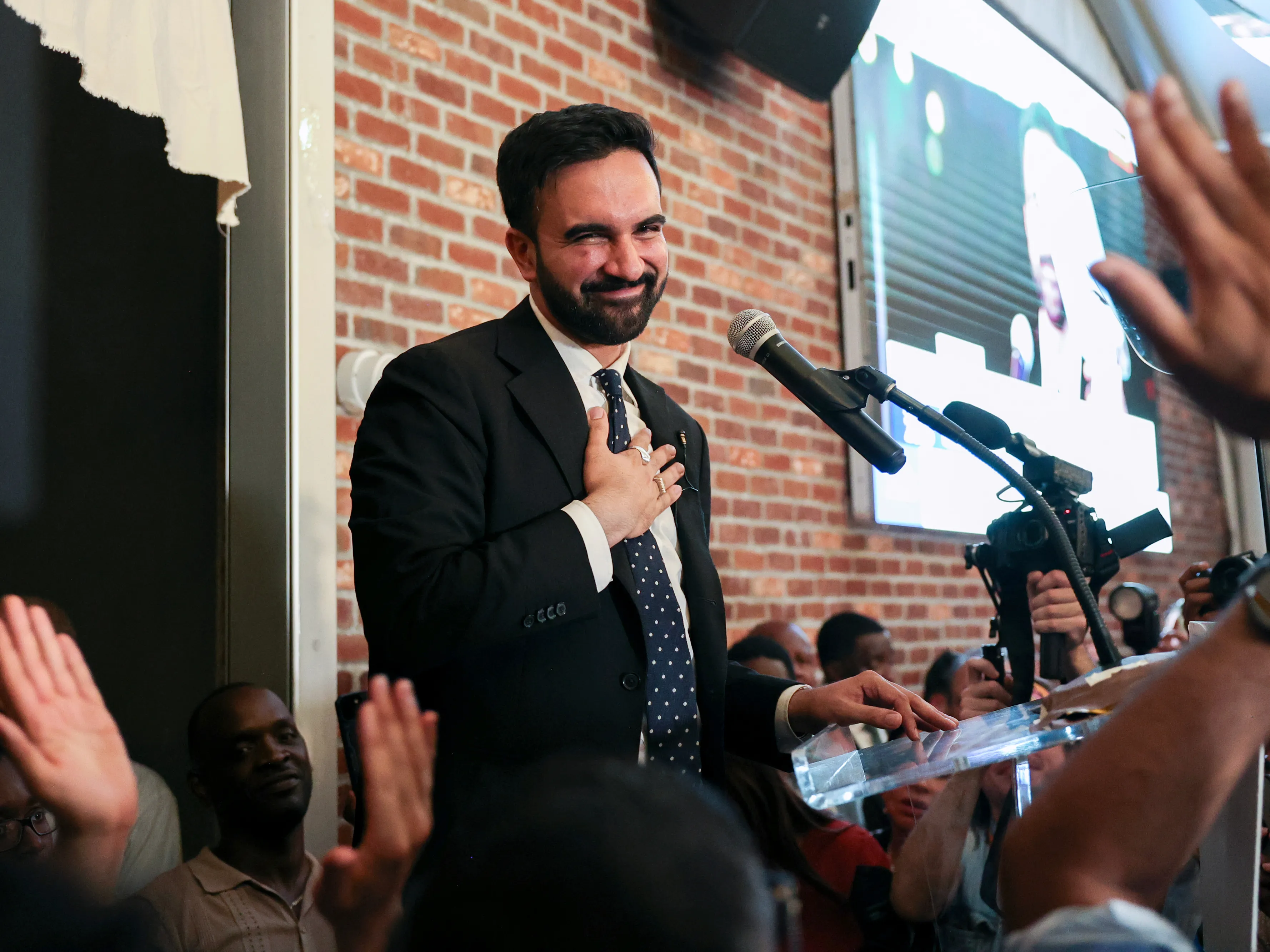
Socialist policies sound great because they are structured to support the less fortunate. The problem is this: In the short term they may provide a lift to the less fortunate, but over the long term they can drive GDP per capita down, impacting everyone. When you remove the incentives for innovation and profit native to capitalist markets, production slows to a halt. Socialism starts with a story of compassion and ends with stagnation. Markets are messy, but they reward value creation. That’s how jobs are made, cities grow, and people move up. Electing someone who doesn’t believe in that may feel good in the moment, but it can take years to undo the damage. David Friedberg said it beautifully on this week's All-In podcast. Watch David's powerful statement here.
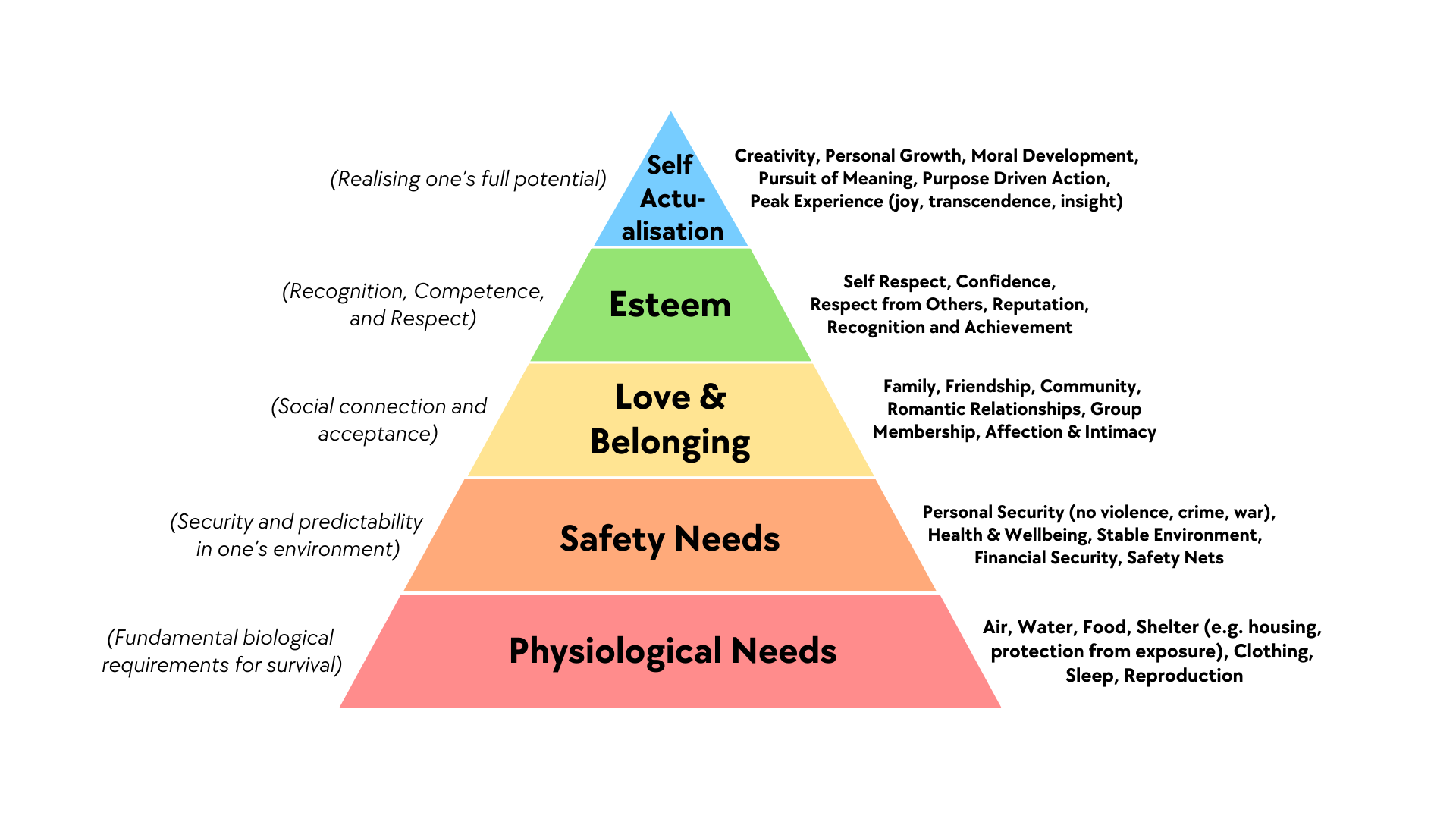
I want to play devil’s advocate for the other side of this argument. My views above reflect my vision of what a strong America looks like, but it’s worth acknowledging that some countries with high levels of wealth redistribution consistently rank among the world’s leaders in GDP per capita, innovation, and quality of life. These nations aren’t socialist; they’re capitalist democracies with robust social welfare systems. So to be clear: the relationship between socialism and economic decline depends heavily on how it's implemented and the broader institutional context. While I may support some redistributive policies, I generally believe in open markets, strong incentives, and a system where anyone has a real shot at rising to the top from hard work. If evaluating socialist policies, I would personally limit the scope to the first two base layers of Maslow's hierarchy of needs:
Anthropic just scored a partial win in a copyright case brought by a group of authors. A federal judge ruled that the company’s decision to scan millions of legally purchased physical books to train its Claude AI model qualifies as fair use. The court called the act “transformative,” giving Anthropic a green light on that front. But not everything went their way. The judge also ruled that Anthropic’s earlier use of pirated ebooks from sites like Books3 and Library Genesis is not protected under fair use. That part of the case will now head to trial.
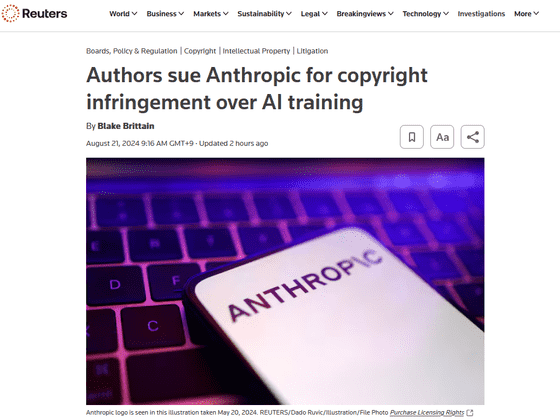
The lawsuit brought to light how Anthropic changed its approach to training data. They started out using large sets of pirated books but later built a more legitimate pipeline. This included buying thousands of printed books, scanning them, and destroying the originals. That process was led by someone with experience in large-scale book digitization. The goal was to create a clean, legally defensible dataset. While the fair use ruling helps AI companies feel more confident using lawful content, the court’s rejection of the pirated material sends a clear warning about cutting corners with unauthorized data.
This ruling matters. For frontier model companies, it shows that creating your own clean dataset is not just a nice-to-have, it’s the safest bet. For content creators, it’s a reminder that their rights still matter, even in an AI world. The final outcome could shape how everyone approaches data collection and training going forward. If you're building in AI, you better make sure your data house is in order.
Since 1996, 29 countries, mostly in Latin America, have criminalized femicide, where once there were none. Decades of activism are reshaping gender-based killings into a clearly defined crime, signaling growing global awareness. While this marks real normative progress, systemic gaps in protection still leave most victims unseen. The next challenge is turning laws into action.
Batteries have become so affordable that solar no longer sleeps. With costs falling fast, solar-plus-storage can now deliver 24/7 power in the sunniest regions, often cheaper than fossil gas. Cities like Muscat and Las Vegas can already meet steady demand 99% of the time, while places like Hyderabad, Madrid, and Buenos Aires are reaching 80 to 95 percent of the way there. The grid is being reimagined.
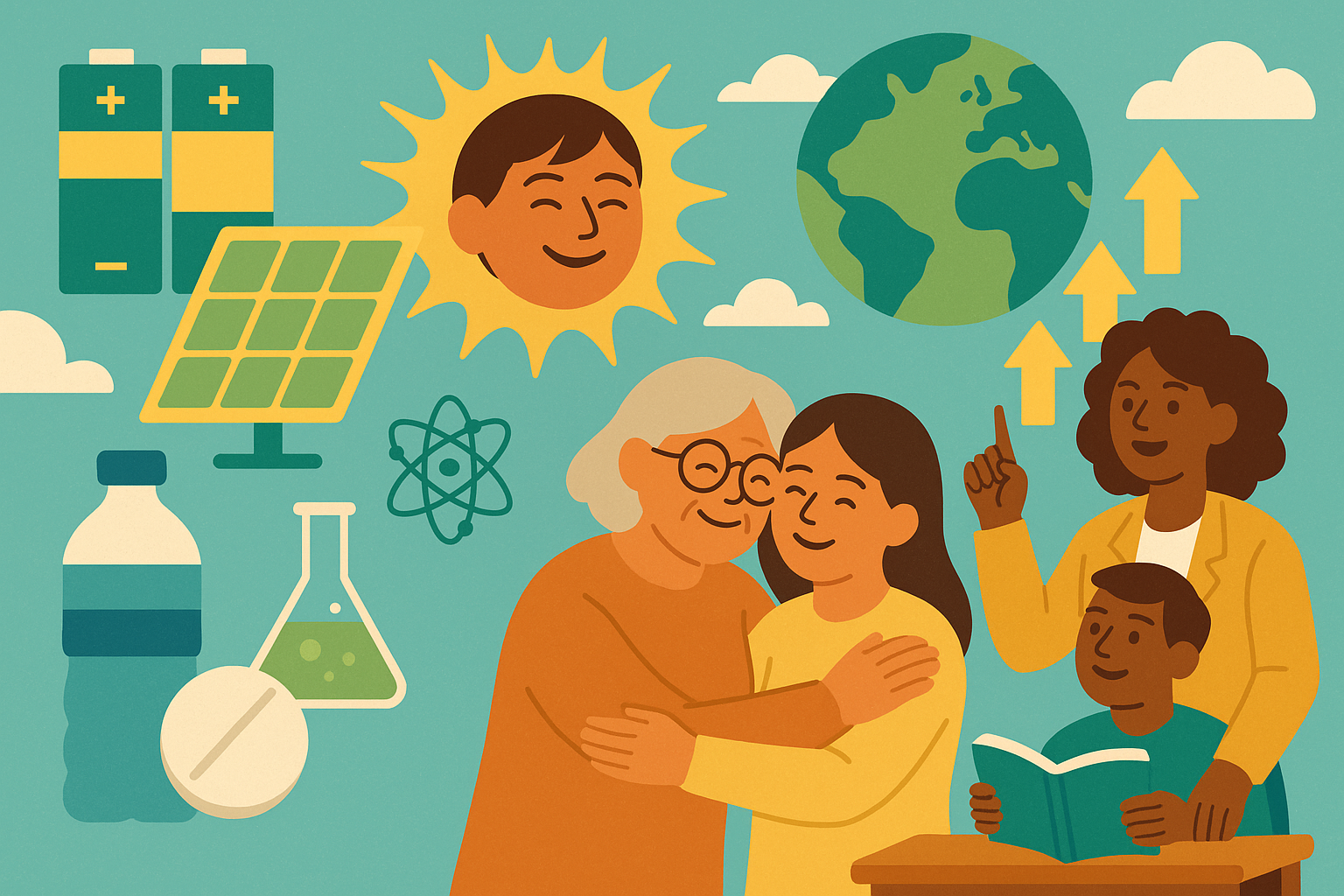
Dementia rates are falling among younger generations. A massive study of 150,000 people across Europe, the UK, and the US found that those born in the 1940s are up to 50% less likely to develop dementia than those born in the 1920s, with the steepest declines among women. Researchers credit better education, cleaner air, and improved heart health. The shift could ease future pressure on caregivers and nursing homes.
Girls’ access to education is rising fast, with gender parity now reached in most regions, including parts of Asia and sub-Saharan Africa, according to a new UNESCO report. In many countries, women now outnumber men in higher education. And when women lead schools in Africa and Southeast Asia, students see learning gains equal to 6 to 12 extra months of education.
Scientists in Edinburgh have engineered bacteria to turn plastic waste into paracetamol in just 24 hours. By adding two genes to E. coli, they created enzymes that trigger a chemical switch, known as a Lossen rearrangement, using a small phosphate boost. The result: leftover plastic becomes painkillers. This “trash to tablet” breakthrough could cut emissions and clean up waste, flipping the pharma supply chain from oil to litter.
Google Cloud just handed over the keys to its Agent2Agent (A2A) protocol. Ownership has been transferred to a neutral governing body, making it a proper open standard. That includes the protocol specs, SDKs, and dev tools—everything needed to keep it alive and useful. The move is meant to keep A2A vendor-agnostic, encourage industry-wide adoption, and avoid a future where agents are locked into closed ecosystems.
A2A lets AI agents find each other, share context securely, and collaborate on tasks using web protocols. Think of it like giving different bots a common language and rulebook. With multiple major tech companies already on board as founding members (shown below), the goal is to speed up development of interoperable AI systems without any single company calling all the shots. That’s rare in today’s tech world — and promising.
This shift is a strong signal that A2A is built for the long haul. It’s no longer just a Google experiment. With neutral governance and broad buy-in, the protocol has a real shot at becoming the foundation for how AI agents talk and work together across platforms. That kind of stability makes it a lot more likely to stick around.
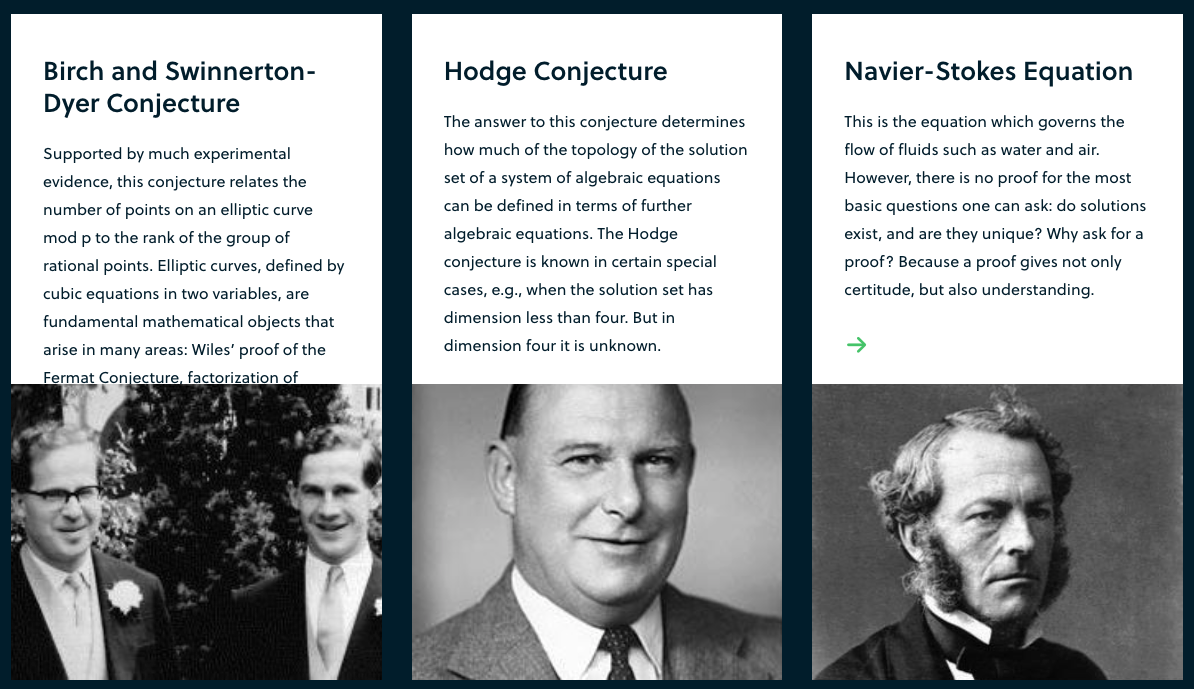
In 2000, the Clay Mathematics Institute unveiled the Seven Millennium Prize Problems — seven of the toughest unsolved problems in all of math. These aren’t your average equations. They represent deep, fundamental questions about the nature of numbers, space, and logic. Solve one, and you get a million bucks and a permanent spot in the math hall of fame. As of now, only one has been solved. The rest are still mocking the best minds in the world.
These problems matter because they sit at the root of countless systems we rely on — physics, cryptography, algorithms, even AI. Cracking one doesn’t just mean bragging rights. It can unlock new fields of research and shift the way we understand the universe. Which brings us to a quietly building story that’s starting to make noise.
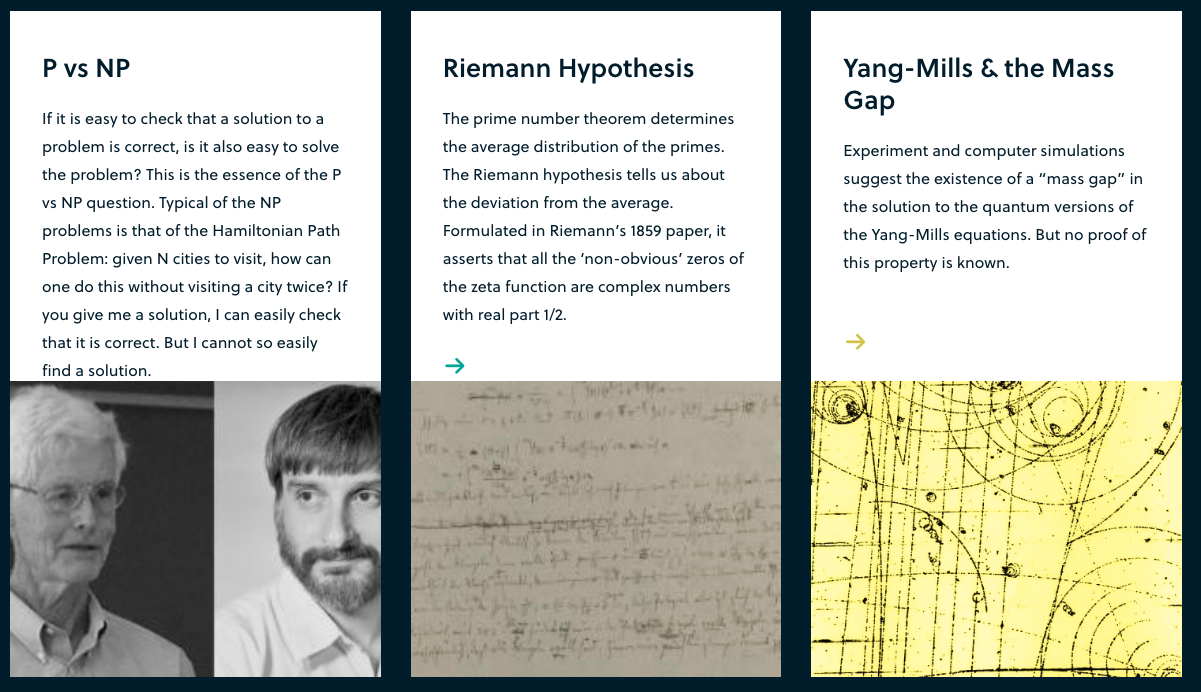
A Spanish mathematician working out of Brown University has been leading a stealthy multi-year effort to tackle the Navier–Stokes (first image) existence and smoothness problem — one of the seven Millennium Problems, focused on fluid dynamics. His team, originally assembled at Princeton and now spread across several top US institutions, mixes traditional math firepower with high-powered simulations. Lately, they’ve been identifying potential fluid singularities that have some experts thinking a breakthrough could happen within five years.

As part of their work, they’ve also built an AI system that can go toe-to-toe with expert mathematicians. In early tests, the system matched or even beat humans in solving high-level math problems. It’s not just a side project. It’s a glimpse at what happens when machines start helping crack the hardest questions we’ve got — possibly speeding up progress in a field that usually moves at glacial pace. If they pull it off, it won’t just be a win for math. It’ll be a win for AI too.
Enjoying The Hillsberg Report? Share it with friends who might find it valuable!
Haven't signed up for the weekly notification?
Subscribe Now