Quote of the week
“Every word has consequences. Every silence, too.”
- Jean-Paul Sartre

Edition 15 - April 13, 2025
“Every word has consequences. Every silence, too.”
- Jean-Paul Sartre
I read an interesting article this week written by Philip Winston. In the article, Philip highlights five predictions he believes will remain true no matter how AI technology evolves. I'd like to share those five things and give my thoughts.
I largely agree with these, and want to highlight the first. The world is extremely complex, especially from an economics perspective. Not only do individual companies have huge incentives to push the frontier forward, but nations do too. I've referenced the race between the US and China before, and I believe these two countries will continue to challenge each other. But within both nations, there will be no single entity given full backing by government.
There are too many avenues of improvement for AI technology for either of these countries to put all their eggs in one basket. Therefore, we will continue to see many model providers who compete with each other nationally and globally. This is a great thing, as it ensures malicious AIs, referenced in the article, have adversarial AIs who can counter them on the same playing field.
One last thought: The magical threshold to AGI or ASI many people are afraid of may not actually exist. The concern that drove countless movies and books is more likely closer to "Edward teller warning that the Trinity nuclear test might ignite the atmosphere." Here is the full article.
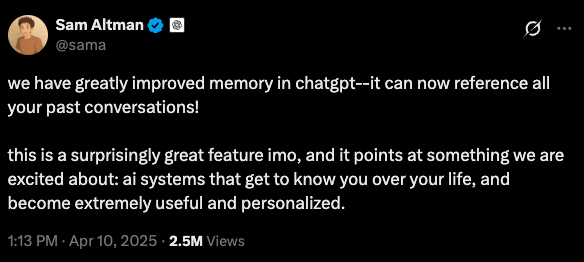
Short memory is one of the biggest challenges that longtime users of LLMs have faced. While working on a recent coding project using Claude, I was ~20 messages into a single thread and began noticing massive deterioration in response usefulness. LLM providers need to figure out how to properly manage context windows and previous conversations. This will unlock enormous improvements in user experience and could be a reason why users migrate from one provider to another without drastic improvement in the underlying model(s).
I haven't had a chance to try out a more complex project in ChatGPT yet, but the viral prompts we've seen in the past, asking ChatGPT to tell us things about ourselves from our prompt history may be more useful moving forward. To me, the best use case for improving this context window is in coding exercises.
A fun prompt to try out: "Now that you can remember everything I've ever typed here, point out my top five blind spots."
What is it?
On April 9 Google announced the Agent2Agent protocol. A2A is a protocol - a universal “language” or rulebook that lets different AI agents communicate, collaborate, and coordinate tasks, no matter who built them.
How does it work?
Think of A2A like a team of people from different countries, all speaking different native languages — but now they’re using a common translator to get things done together. Here's how they do it:
Why does this matter?
Without A2A, agents are like employees who don’t speak the same language. With A2A, they become a super-coordinated team—sharing knowledge, working together, and saving you time.
More importantly, how does this impact MCP?
A2A does not replace MCP — instead, it operates at a complementary layer. Think of MCP as "what an agent knows and remembers" and A2A as "how agents talk and collaborate with each other." Additional impacts are as follows:
How does A2A enhance the MCP capabilities?
Lastly, how will A2A and MCP work together?
MCP will act as an Agent's internal brain, holding knowledge, memory, tools, and instructions. It will define what an agent can do and how it interprets context. A2A will handle communication with external agents. It will define how tasks, artifacts, and instructions are exchanged.
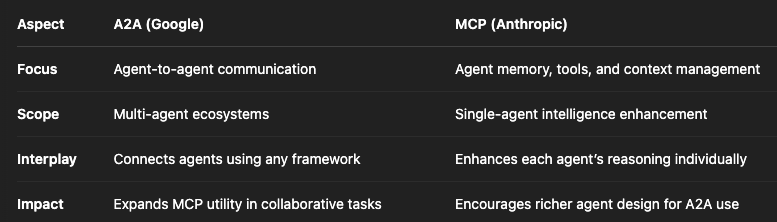
This is the future of applications, people. Better get up to speed fast. Here is the full article from Google. It's also worth noting that Google has said it'll embrace MCP.

Ambulances Saving Lives in Sri Lanka: 88 ambulances donated by India have helped save over 1.5 million lives in Sri Lanka, highlighting the impact of international aid.
Eastern Monarch Butterfly Population Surge: The population of eastern monarch butterflies nearly doubled in 2025, signaling positive trends for this endangered species.
Beavers Return to England: For the first time in 400 years, beavers have been reintroduced to the River Clun in Shropshire. Their presence is expected to help restore natural habitats through their dam-building activities.
Google is firing on all cylinders. Firebase was acquired by Google back in 2014 and since then has been expanded into a comprehensive platform for building mobile and web applications. Firebase Studio is a new tool providing an IDE (Integrated Development Environment) for building and deploying Firebase-based applications.
So, what's the difference between Firebase Studio and a tool like Cursor? Cursor is an AI-assisted code navigation tool with no specific ecosystem set. Firebase Studio can help folks with little experience stand up more comprehensive applications utilizing many parts of the Firebase ecosystem.
How does Firebase Studio compare to Lovable? Lovable is a UI/UX design tool and is powered by Supabase on the backend. Supabase has a similar tech stack to Firebase, with some differences in database type, pricing models, and other characteristics. Firebase Studio has similar capabilities to Lovable, but is also a comprehensive all-in-one application development platform. If you want to build an app and know what you're doing, you may prefer Supabase to Firebase. If you have no idea what you're doing, Firebase Studio may be your key.
Firebase Studio can be found here.
This X thread contains some use cases and examples.
I have a feeling that something significant is going to happen between the US, China, and Taiwan in the near future. The US is heavily reliant on Taiwan for chips, and with the tariff war in progress, the US might be forcing China's hand. This is an extremely complex global geopolitical and economic environment, and I don't know nearly enough to speculate, so I'll just say that I feel like something big is going to happen soon. If you didn't catch on by now, TSMC is based in Taiwan.
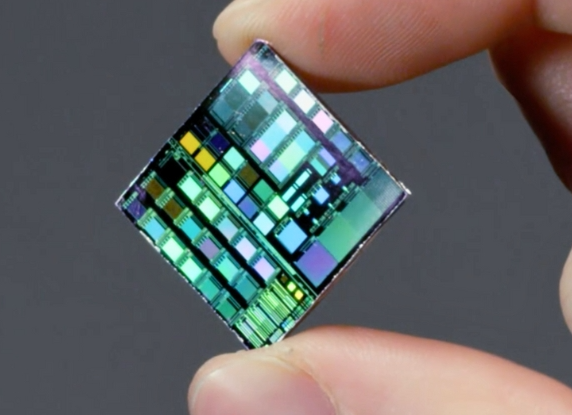
On April 1, TSMC unveiled the world's most advanced microchip: the 2nm chip. This new chip promises a significant leap in performance and energy efficiency, with potential benefits including a 10-15% boost in computing speed or a 20-30% reduction in power usage. The 2nm chips also feature a 15% increase in transistor density compared to the previous 3nm chips, enhancing speed and energy efficiency. The advancements could lead to faster, smaller devices and improved AI applications, autonomous vehicles, and data centers.
However, challenges remain, particularly in manufacturing, which requires complex techniques like extreme ultraviolet lithography. Heat dissipation is another issue, as smaller transistors generate more heat due to higher power density. Additionally, the use of traditional materials like silicon may need to be reconsidered as chips continue to shrink.
Despite these hurdles, the 2nm chips are expected to drive innovation in consumer and industrial computing, enabling smaller, more powerful, and environmentally friendly devices. TSMC’s dominance in the global microchip market has made it a key player in both the tech industry and Taiwan's security landscape.
Enjoying The Hillsberg Report? Share it with friends who might find it valuable!
Haven't signed up for the weekly notification?
Subscribe Now